
Darwin to Broome 4WD Hire
Yes, you can pick up a 4WD camper in Darwin and drop it off in Broome. One-way hires are on request, with a 2-week minimum. The one-way fee is $500, waived if you hire for 3 weeks or more. Start with the Top End's waterfalls and finish on the Gibb River Road.
| Distance | About 1,870 km on the highway (Victoria Highway and Great Northern Highway). The Gibb River Road itself is about 660 km of mostly unsealed road between Kununurra and Derby |
|---|---|
| Minimum hire | 2 weeks (one-way minimum) |
| Suggested days | 14 or more |
| Gibb River Road | Approved for both vehicles once it officially opens for the dry season; creek crossings up to 0.5 m |
| Best season | May to September (dry season) |
| When it runs | By season: ask us which dates are open |
| Vehicles | Premium Explorer or Comfort Camper |
| Pickup | Darwin depot, Yarrawonga |
| Drop-off | Broome depot |
| One-way fee | $500 for hires under 3 weeks. No fee for 3 weeks or more. |
| Kilometres | Unlimited |
Top End first, then the Kimberley
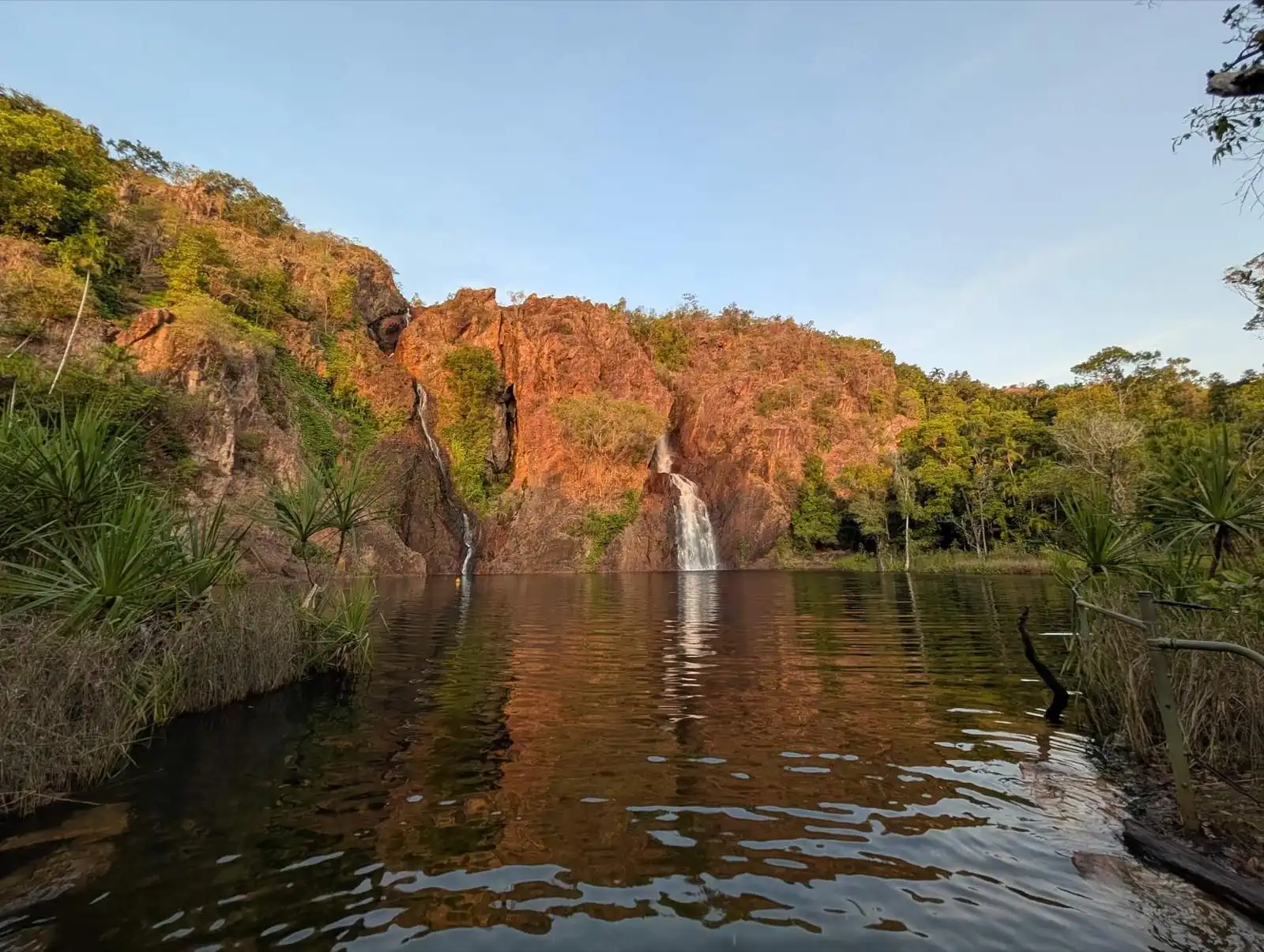
Starting in Darwin puts the Top End first: Litchfield National Park (Florence Falls, Wangi Falls, Buley Rockhole), Nitmiluk (Katherine Gorge), the Mataranka thermal pools and Kakadu. From Katherine, the Victoria Highway heads west to Kununurra and the eastern end of the Gibb River Road. Our Darwin, Kakadu, Katherine and Litchfield guide covers the Top End half.
The Gibb River Road or the highway
Both campers are approved for the Gibb River Road once it officially opens to the public for the dry season. Creek crossings must be no deeper than 0.5 m, and some side roads are allowed: ask us about yours. Our cover and recovery stop at Drysdale River Station on the Kalumburu Road: north of there is at your own risk. Highlights include Adcock, Manning and Bell Gorge, then Windjana Gorge and Tunnel Creek near the western end. The sealed highway through Halls Creek and Fitzroy Crossing is the alternative.
Bungle Bungles (Purnululu): allowed when the access road is open and conditions permit, but take extreme care. Conditions change through the season (the road was treacherous in 2026), so check the latest Purnululu National Park access updates before you go.
When to go
May to September, the dry season, at both ends. From November to April many Top End areas close, and most Kimberley tracks and national parks close with flooding. Waterfalls such as Gunlom and Jim Jim close seasonally.
One-ways between our locations follow the seasons. Broome hires run mostly in the dry season, and our vehicles leave Broome and Darwin by mid to late October. Ask us which dates are open for Darwin to Broome.
Which vehicle
Both our campers suit this trip. Our operations team's advice:
- Premium Explorer (2025 Toyota Hilux camper): the better touring vehicle. An upright 130 L fridge, pull-out drawers and a table make lunch stops easy, Starlink (50 GB included) keeps you connected where there's little or no signal, and there's more room for luggage and groups of 3 to 5.
- Comfort Camper: Toyota Prado camper (150 or 250 Series): the budget-friendly choice. Extremely capable, and best for smaller groups who don't mind packing up each day. It has a 45 L chest fridge and no Starlink.
Pickup and drop-off
Pick up at our Darwin depot in Yarrawonga and drop off at our Broome depot. Darwin has no airport pickups or drop-offs: the depot is within 20 minutes of the airport, so grab a taxi or Uber. Depots are open Monday to Friday, 9am to 5pm, with weekends by appointment.
Cost
One-way fee: $500 for hires under 3 weeks. No fee for 3 weeks or more. Kilometres are unlimited. See the daily rates on the Premium Explorer and Comfort Camper pages. For an exact price, check your dates online or call 1300 209 025.
Good to know
- Where you can't drive includes ungazetted roads, unformed tracks, river, creek or tidal crossings deeper than 0.5 m, floodwaters and flood-prone roads, closed roads or roads under police or government warnings, roads likely to damage the vehicle, salt lakes and flats, above the snow line, and below the high-tide mark. In Western Australia, the Canning Stock Route is also off limits. The full list is in our Terms and Conditions.
- Breakdown cover: on council-owned or council-maintained roads only, not on national park 4WD tracks, other roads that aren't council-maintained, or prohibited areas. Help can take a while to reach you, so carry enough food, water and supplies for delays.
- Not included: permits, ferry tickets and campsite bookings. You arrange these.
- Your briefing: every hire starts with one, about an hour long.
More routes: all our itineraries.
Plan Your Own Route
Build your own 4WD adventure, one leg at a time, with our Adventure Builder.
Frequently Asked Questions
Do you have a cancellation policy?
Yes. Cancellations must be made in writing, and the fee is a percentage of your total rental fee based on how much notice you give before pickup.
- 60 days or more: 15%
- 30 to 59 days: 30%
- 8 to 29 days: 75%
- 2 to 7 days: 90%
- 1 day or less, or no show: 100%
You can also view our cancellation policy here.
What time can I pick up/drop off my vehicle?
All pickup and drop-off times must be arranged with us before your hire, as our depots aren't always staffed.
Our depots are open Monday to Friday, 9am to 5pm. Weekend pickups and returns are available by appointment.
Is there an age restriction for hiring a 4WD?
Yes. All drivers need to be 21 years old or older.
What if I return the vehicle late?
Please return your vehicle at the time arranged with our team. If you're running late, call us as soon as you can.
Late returns are charged at $50 per hour (or part hour) for the first two hours after your scheduled return time. If you're more than two hours late, a full extra day's hire is charged at your rental rate.
Will I need to pay a bond to hire a 4WD?
Yes. The bond is $5,000, or $500 if you take the optional excess reduction ($69 a day). If any driver is under 25, the bond is $5,000, as excess reduction isn't available.
The bond is pre-authorised on your credit card 1 to 2 business days before pickup. For hires of 30 days or more, it's charged rather than pre-authorised. Either way, it's released 5 to 10 business days after you return the vehicle, subject to inspection.
Can I be picked up from the airport in the event I'm flying in, not driving?
No. We don't offer airport collections or returns. All pickups and drop-offs are at our depots, where we give you a full vehicle walkthrough and briefing before you set off.
Is insurance included?
Yes. All hires include Compulsory Third Party (CTP) insurance. CTP covers personal injury only, not damage to the vehicle or other property, so you're liable for vehicle damage up to your excess.
The standard excess is $5,000. Optional excess reduction costs $69 a day (capped at $3,105, or 45 days) and reduces your maximum liability to $500. It also adds extra roadside cover:
- two tyre replacements
- up to three tyre puncture repairs
- up to two rim replacements
- one windscreen replacement
- unlimited windscreen chip repairs
Excess reduction isn't available if any driver is under 25.
There's no full cover (zero excess) option. Damage caused by negligent driving, driving on prohibited roads or tracks, or anything else that breaches the rental agreement isn't covered under any option.
For full details, see our Terms and Conditions.
Do I need to bring my own camping equipment?
You don't have to bring your own gear, but you're welcome to if you prefer.
Our Comfort Camper and Premium Explorer vehicles come fully equipped with everything you need for camping, at no extra cost.
Do I need to clean the vehicle before returning it?
Vehicles must be returned in a reasonably clean condition. An additional cleaning fee of up to $100 may apply if extra cleaning is required.
Is there a minimum period for hiring a vehicle?
Yes. The minimum hire depends on the location, the season and whether you're returning to the same depot.
- Broome, Cairns, Darwin and Perth (same pickup and drop-off): minimum 5 days off-peak and 10 days in peak (1 June to 30 September).
- Alice Springs: minimum 2 weeks all year, for any hire starting or ending in Alice Springs.
- One-way hires: minimum 2 weeks, or 3 weeks between Perth and Cairns (either direction).
Chat with our team if you'd like us to check your dates.
What type of driver's licence do I need?
All drivers must hold a current, full driver's licence that they have held for at least 1 year.
Overseas licences are welcome. If your licence isn't in English, you'll also need to carry an International Driving Permit (IDP) with your original licence.
Do your vehicles come with Starlink internet?
Premium Explorer (Toyota Hilux camper): yes. Starlink internet is included as standard, with 50GB of data to get you started. If you need more data during your trip, just get in touch and we'll top it up and charge the card on file.
Comfort Camper (Toyota Prado, 150 and 250 Series): no. Starlink isn't available in our Prados at this time.
What happens if I drop the car back early?
There are no reimbursements for early returns. The vehicle is reserved exclusively for your full booking period, and choosing to return it earlier does not entitle you to a refund.
Do I need a 4WD for Kakadu and Litchfield, or will a 2WD do?
Many of the main attractions in Kakadu and Litchfield are accessible by 2WD. However, if you want to explore further off the beaten track and visit some of the more remote, scenic waterfalls and swimming spots, a 4WD is recommended.
Can I drive a hire 4WD to Jim Jim Falls and Twin Falls?
Yes, our 4WD vehicles can access Jim Jim Falls and Twin Falls when the roads are open and conditions permit. Both require 4WD access, and road conditions can vary significantly throughout the season.
Jim Jim Falls is subject to seasonal closures, and in some years it doesn't open at all (it stayed closed for the whole 2026 season). Access to both falls can change depending on weather and road conditions, so always check the latest Kakadu National Park access updates before travelling.
We strongly recommend having alternative destinations in mind so you're not disappointed if access is restricted or roads remain closed.
Are 4WD tracks in Litchfield, like the Lost City and the Reynolds River Track, allowed in your vehicles?
Yes, the Lost City and Reynolds River Track are permitted, provided conditions are suitable. Water crossings must not exceed 0.5 metres in depth, and road conditions, weather and water levels should always be assessed before proceeding. Hirers are responsible for checking current conditions and ensuring all travel complies with the rental agreement.
Do I need a Kakadu park pass, and how do I get one?
Yes, a Kakadu National Park pass is required for all visitors. You can purchase your pass online before travelling through the official Kakadu National Park website.
Which parts of Kakadu and Litchfield are open in the wet season?
Both Kakadu and Litchfield remain open during the wet season, but access to individual attractions, roads and walking tracks can be heavily affected by rainfall and flooding.
Kakadu: Some popular attractions remain accessible year-round, including Ubirr, Burrungkuy (Nourlangie) and Yellow Water. However, many remote areas, waterfalls, campgrounds and 4WD tracks close due to flooding and unsafe road conditions.
Litchfield: Some of the main attractions, including Florence Falls, Buley Rockhole and Wangi Falls, may remain accessible, although swimming areas and access roads can close at short notice. Remote 4WD tracks, including the Reynolds River Track, are particularly dependent on water levels and road conditions.
Wet season travel can be spectacular, but flexibility is essential. We recommend checking the latest park access reports before setting off, having alternative destinations in mind and never attempting flooded roads or water crossings beyond the vehicle's permitted limits.
Please remember: Park access can change daily, so don't rely on previously published itineraries or older travel reports.
What's a good 5 to 7 day loop from Darwin through Litchfield, Katherine and Kakadu?
Here's a suggested 5–7 day loop through Litchfield, Katherine and Kakadu, based on a recent trip by one of our team members. It's a fairly active itinerary with plenty of driving and sightseeing, so feel free to adjust it to suit your pace.
Day 1 – Darwin to Litchfield National Park
- Stock up on food, supplies and firewood in Darwin.
- Stop at Berry Springs for a swim.
- Explore Litchfield, including Buley Rockhole, Tolmer Falls and Wangi Falls.
- If time allows, finish with the walking track around Wangi Falls and sunset at the falls.
- Overnight at Wangi Falls Campground.
Day 2 – Litchfield to Katherine
- Head south, stopping for lunch at The Lazy Lizard in Pine Creek.
- Enjoy a swim at Edith Falls, including the upper pool walk if time permits.
- Continue to Katherine and overnight at Gorge View Bush Retreat.
Day 3 – Katherine to Kakadu
- Morning Nitmiluk Gorge cruise.
- Visit Katherine Hot Springs.
- Continue towards Kakadu, stopping at Gunlom Falls if open and accessible.
- Overnight at Gunlom Campground.
Day 4 – Southern Kakadu
- Explore Kakadu's spectacular waterfalls, including Maguk and Jim Jim Falls, subject to seasonal access and closures.
- Allow plenty of time for the walks.
- Overnight around the Cooinda area.
Day 5 – Cooinda to Jabiru
- Enjoy a Yellow Water Billabong Cruise (highly recommended for spotting crocodiles and wildlife).
- Head to Jabiru and check into Aurora Kakadu Lodge.
- Visit Cahills Crossing for crocodile spotting (stay well back from the water).
- Finish the day at Ubirr for the incredible rock art and sunset views.
Day 6 – Central Kakadu
- Explore Nourlangie (Burrungkuy), Nawurlandja Lookout and Bowali Visitor Centre.
- Enjoy a more relaxed afternoon back at camp.
Day 7 – Return to Darwin
- Take a leisurely drive back to Darwin.
- If time allows, stop at Berry Springs for one last swim before returning the vehicle.
A few helpful tips:
- Check national park websites for current road conditions, seasonal closures and swimming access before travelling.
- Avoid driving at dusk and after dark, particularly in remote areas where wildlife is common.
- Never swim in rivers, billabongs or unapproved waterholes. Stay well back from water edges, particularly in crocodile country.
- Book campsites and cruises ahead of time, particularly during peak season.
- Carry plenty of drinking water, including when leaving the vehicle.
Our advice: This is a fairly ambitious loop, particularly in the first few days. If you have seven full days plus your return day, consider adding an extra night in Litchfield or Katherine to slow things down.
And one final tip from our team member: bring a pair of Crocs/water shoes for camp and waterfall visits – apparently, they're a game changer! 😅
Can I visit Arnhem Land in a hire 4WD, and do I need a permit?
Yes. Travel to Arnhem Land is permitted in our hire 4WDs, but there are a couple of important requirements.
You must let us know your plans in advance and have an approved Arnhem Land access permit before booking. This allows us to confirm your intended route and ensure everything is in order before your hire.
Please get in touch with our team if you're considering visiting Arnhem Land, and we'll be happy to help.
Is it safe to swim at Kakadu and Litchfield waterholes?
Yes! Kakadu and Litchfield have some incredible swimming spots, and many of the designated swimming areas are safe to enjoy when officially open.
However, it's important to remember that this is crocodile country. Saltwater crocodiles can be found throughout the Top End, including in freshwater environments.
A few things to keep in mind:
- Only swim in designated swimming areas that are officially open and signed as safe.
- Never swim in rivers, billabongs or unapproved waterholes, even if they look inviting.
- Always check for current swimming restrictions and park alerts, as closures can change throughout the year.
- Never assume a swimming spot is safe just because other people are swimming.
Both parks have some spectacular swimming spots, so with a little planning and by following local advice and signage, you can enjoy some fantastic swims along the way!
Can I hire a 4WD one way?
Absolutely! We offer one-way 4WD hires between our outback depots, including Perth and Broome, Broome and Darwin, Darwin and Alice Springs, and Perth and Cairns, in either direction.
One-way hires have a minimum of 2 weeks (including any hire starting or ending in Alice Springs), or 3 weeks between Perth and Cairns. A $500 one-way fee applies to hires under 21 days, and it's waived for hires of 21 days or more.
Get in touch with your preferred dates and we'll help work out the best option for your trip!
How much is the one-way fee?
The one-way fee is $500 for hires under 21 days. For hires of 21 days or more, the one-way fee is waived.
The minimum one-way hire is 2 weeks (including any hire starting or ending in Alice Springs), or 3 weeks between Perth and Cairns.
How many days do I need to drive between Perth and Broome?
It really depends on how much you want to see along the way! If you're travelling along the coast, 2–3 weeks is generally a good amount of time. If you'd like to explore further inland, take a few detours and enjoy a slower pace, you may want to allow longer.
Feel free to get in touch and chat with us about your itinerary. We're always happy to help you plan the journey!
Can I take a hire 4WD on the Gibb River Road?
Absolutely! The Gibb River Road is exactly the kind of country our vehicles are built for.
A 4WD is essential for tackling the rocky terrain, corrugations and multiple water crossings along the way. Our premium 4WDs are purpose-equipped for outback touring, with the Gibb River Road in mind, so you'll be well set up for the adventure.
How long does it take to drive from Broome to Darwin via the Gibb River Road?
The Gibb River Road itself is approximately 660km long, but there's so much to see and do along the way that it's worth allowing plenty of time to explore.
While every itinerary is different, we recommend allowing a minimum of 2 weeks to travel from Broome to Darwin via the Gibb River Road. Longer is even better if you want to take your time, explore the gorges, swim in waterholes and really enjoy the Gibb experience!
Gibb River Road or the Great Northern Highway: which route should I take from Broome to Darwin?
It really depends on the type of trip you're after and the time of year you're travelling. If the Gibb River Road is open, we'd almost always recommend taking it!
Why stick to the highway when you could explore spectacular gorges, swimming holes, incredible campsites and some of the Kimberley's most beautiful scenery?
Just keep in mind that while the Gibb might look like a shortcut on the map, it's a much slower drive due to the rougher terrain and plenty of places worth stopping along the way. Our advice? Allow plenty of time, take it slow and enjoy the journey!
Are there roads or areas I'm not allowed to drive on?
Yes. While our vehicles are equipped and permitted for off-road travel, there are certain tracks and areas that are off-limits.
This largely comes down to vehicle recovery and breakdown support, as our roadside assistance providers need to be able to access you if something goes wrong. Some remote areas may also be accessible at your own risk.
We recommend checking your rental agreement for the most up-to-date list of permitted and restricted areas before setting off.
Is a hire 4WD capable of river crossings like the Pentecost?
Yes! Our 4WDs are equipped for river crossings such as the Pentecost.
There are a few important things to keep in mind:
- Maximum water depth: Our rental agreement prohibits water crossings deeper than 0.5m.
- Crocodile country: In northern WA and the NT, never enter the water to check a crossing on foot.
- Check conditions: Always check water depth markers where available and seek the latest local advice from stations, councils or authorities before attempting a crossing.
Remember, water levels and conditions can change quickly. If you're unsure, don't attempt the crossing. Your safety and the vehicle's safety come first.
Do I need 4WD experience to drive the Gibb River Road?
Not necessarily. You don't need to be an experienced 4WD driver, but you do need to have a prepared, sensible and problem-solving mindset.
Remember, you're travelling through remote territory, so a little preparation goes a long way. Do your research, check road conditions before setting off and don't be afraid to ask questions along the way.
You can also lean on us! Our team have all driven the Gibb River Road at least once, so if you're unsure about something or need a bit of guidance, just ask. We're always happy to help!
Which vehicle is best for the Kimberley: Hilux or Prado?
Both the Hilux and Prado are excellent choices for exploring the Kimberley. The best option really comes down to your group size, camping style, luggage requirements and budget.
Prado – Best for couples and smaller groups
Our Prados (2018 to 2026, 150 and 250 Series) are a great option for 2–3 travellers. They're comfortable, extremely capable off-road and set up for touring. The main consideration is luggage space, as the boot is largely occupied by your camping equipment, leaving limited room for additional bags.
Fuel range depends on the model. The 150 Series has a long-range 150 L tank, while the newer 250 Series has a 110 L tank and also needs AdBlue, so plan your fuel stops on remote stretches like the Gibb.
Hilux – Best for a more premium camping experience
Our Hilux is the more premium touring setup, featuring a custom Norweld canopy, upright fridge, built-in power system and Starlink. It offers more practical storage and can accommodate up to 5 people, making it a great option for families or larger groups.
Ultimately, both vehicles are well equipped for the Kimberley. It's just a matter of choosing the setup that best suits your adventure!
When is the best time of year to drive from Broome to Darwin?
The best time to travel from Broome to Darwin via the Gibb River Road is generally during the dry season (May to September).
June, July, August and September are our preferred months, offering more reliable road conditions and more comfortable temperatures for exploring the Kimberley.
A few things to keep in mind:
- May and October: The months either side of the dry season can be unpredictable. The Gibb River Road opening date varies each year depending on rainfall and road conditions.
- June to September: Generally the best window for travelling, with drier conditions and easier access to gorges and attractions.
- School holidays: If you'd prefer fewer crowds at popular campsites and swimming holes, consider travelling outside the school holiday periods.
Our advice? Aim for June to September, allow plenty of time and keep an eye on road conditions before setting off!
Is the Gibb River Road open in the wet season?
No. The Gibb River Road typically closes during the wet season, roughly between October and May.
However, closure dates vary from year to year depending on rainfall, flooding and road conditions. Some sections may close earlier or reopen later than others.
Always check the latest road conditions and official opening announcements before planning your trip.
Can I hire a 4WD in the wet season (November to April)?
As a general rule, we move our vehicles south for the summer months and back north for the dry season.
However, there may be opportunities to hire from Broome or Darwin during the seasonal changeovers. We sometimes offer special rates for vehicles travelling south at the end of the season or north at the beginning.
If you have specific dates or a route in mind, get in touch and we'll see what we can make work!
How much does 4WD camper hire cost per day?
Our 4WD campers start from $225 a day. The daily rate depends on the vehicle, the season and how long you hire for, and longer hires get a lower rate.
- Premium Explorer (2025 Hilux camper): $270 to $370 a day off-peak, $385 to $529 a day in peak.
- Comfort Camper (2018 to 2026 Prado, 150 or 250 Series): $225 to $310 a day off-peak, $250 to $360 a day in peak.
- Beach Cruiser (K'gari only): $225 to $395 a day off-peak, $270 to $395 a day in peak.
Peak is 1 June to 30 September for the Hilux and Prado (Alice Springs, Broome, Cairns, Darwin and Perth). On K'gari, peak is school holidays and long weekends. All rates are per vehicle, per day, in Australian dollars including GST.
For your exact price, check your dates online or call 1300 209 025.
What insurance or damage cover is included, and does it cover gravel roads, windscreens and tyres?
Every hire includes CTP insurance, which covers personal injury only. You're liable for damage to the vehicle up to your excess. There's no full cover option.
Alice Springs, Broome, Cairns, Darwin and Perth: the standard excess is $5,000. The optional excess reduction ($69 a day) lowers it to $500 and adds two tyre replacements, up to three tyre puncture repairs, up to two rim replacements, one windscreen replacement and unlimited windscreen chip repairs. Excess reduction isn't available if any driver is under 25.
K'gari (Rainbow Beach): the excess is $15,000, $2,500 or $1,000 depending on the option you choose. Drivers under 25 can take the Play it Safe option only.
Damage caused by negligent driving, driving on prohibited roads or tracks, or anything else that breaches the rental agreement isn't covered. What's covered on gravel roads, and the full conditions, are set out in our Rental Agreement.
Are kilometres unlimited?
Yes! All our hires include unlimited kilometres, so you can explore without worrying about a daily kilometre allowance.
For longer trips, we may need to arrange a mid-hire service to keep the vehicle properly maintained and compliant. If this is required, we'll organise and cover the cost of the service, working around your itinerary as much as possible to minimise any disruption to your trip.
What's the minimum age to hire a 4WD, and can I use an overseas licence?
The minimum age to hire one of our 4WDs is 21 years, and drivers must have held a valid driver's licence for at least 1 year.
Overseas licences are welcome. However, if your licence isn't in English, you'll also need to carry an International Driving Permit (IDP) alongside your original licence.
Please also check the licence requirements for the state or territory you're travelling in. If your trip crosses multiple states or territories, make sure you meet the requirements for each.
What recovery gear and spares come with the vehicle?
All vehicles come equipped with recovery boards and at least one spare tyre.
For K’gari hires, vehicles include recovery boards and one spare tyre.
For all other locations, vehicles also include an air compressor and either one or two spare tyres, depending on the vehicle type.
What happens if I break down in a remote area, and is recovery included?
If you break down in a remote area, breakdown recovery is included on council-owned or council-maintained roads.
However, recovery is not covered on 4WD tracks within national parks or on roads and tracks that are not council-maintained. It's important to check your planned route and understand where breakdown cover applies before setting off.
What's included in a 4WD camper hire?
Our 4WD campers come equipped with the essentials to get you out on the road and ready for adventure! What's included varies slightly between vehicles, so we'd recommend checking out the individual vehicle specifications in our Our Vehicles section for a full breakdown of equipment and inclusions.
Where do I pick up my vehicle, and what are the depot hours?
All pickups and drop-offs are at our depots. We don't offer airport collections or returns. Handing over at the depot lets us give you a full vehicle walkthrough and briefing, so you're familiar with the vehicle and all its equipment before setting off.
Depot hours (Alice Springs, Broome, Cairns, Darwin and Perth):
- Monday to Friday, 9am to 5pm.
- Weekends by appointment.
Whatever day you're collecting or returning, your exact time must be arranged with us in advance, as our depots aren't always staffed.
On K'gari, pickups and drop-offs are by appointment only, and times depend on the tides.
We recommend allowing a little extra time for your handover so you can get familiar with everything before hitting the road!